


PLATINUM Dog Food: Fleischsaftgarung (FSG) and How to Choose?

8 min read
5 August 2026

Dry dog food is not always hard and crunchy. PLATINUM dog food looks familiar in the bag, but its pieces are softer and chewier than conventional kibble. The reason is a production method with a rather long German name: Fleischsaftgarung, usually shortened to FSG.
The name can be translated as “meat-juice cooking.” PLATINUM says fresh meat is cooked under vacuum at a relatively low temperature, without added water or broth, while the meat juices are gradually reduced. That sounds interesting, but a cooking method is only one part of the picture. The complete recipe, nutritional balance and your dog's own needs still matter more than the name of the process.
Let's take a closer look at what FSG means in practice and how to read the PLATINUM range without getting lost in front-of-pack claims.

So, who is PLATINUM?
PLATINUM is German pet-food company based in Bingen. According to the company's official milestones, founder Rainer Voortman and two friends began developing their cooking method in 2000, and the company was founded in 2004.
The brand now makes dry and wet dog food, treats and care products. This article focuses on its soft dry food, which is the part of the range most closely associated with Fleischsaftgarung.
PLATINUM emphasises fresh meat and describes its ingredients as suitable for human consumption. It is worth keeping that wording in context: pet food in Europe is regulated as animal feed, not as human food. More importantly, “human-grade” does not tell you whether a food is complete, appropriate for your dog's life stage or suitable for a medical need. In case of PLATINUM food range, the food is complete.
What does Fleischsaftgarung actually mean?
PLATINUM's description of FSG combines two familiar kitchen ideas: vacuum cooking and reduction. Fresh meat is cooked in its own juices under vacuum. Moisture is then slowly reduced until a shelf-stable, soft piece of food remains. No water or broth is added during this stage.
Standard Adult recipes declare about 19% moisture, while products across the wider dry range generally sit around 18–20%. This helps explain the chewy texture. For comparison, FEDIAF's pet-food labelling code uses “dry” for foods with no more than 14% moisture and “semi-moist” for foods between 14% and 60%. PLATINUM sells the product as dry food, but its texture and moisture are closer to the semi-moist category than to crisp kibble.
Most conventional kibble is made by extrusion. Ingredients are mixed into a dough, cooked with heat and pressure, shaped and dried. FSG follows a different route, but different does not automatically mean better. Research on extrusion shows that processing can have both useful and unwanted effects: it may improve starch and protein digestibility and help control undesirable compounds, while also reducing some heat-sensitive nutrients. The result depends on the ingredients, time, temperature and final formulation—not simply on whether a food is extruded or vacuum-cooked. A peer-reviewed review of extrusion explains these trade-offs in more detail.
PLATINUM says FSG preserves natural flavours and nutrients and makes the food especially digestible.
What does the independent testing show?
PLATINUM commissions ELAB Analytik GmbH to test its products. The laboratory's published PLATINUM test plans cover the declared fresh-meat content, basic composition, heavy metals, mycotoxins and a range of microorganisms. The plans state that laboratory testing is carried out periodically and that fresh-meat content is checked through a production-site audit.
That is useful quality-control information. It supports checking whether the product matches its declaration and whether specified contaminants are within the tested parameters.
What is in PLATINUM dry dog food?
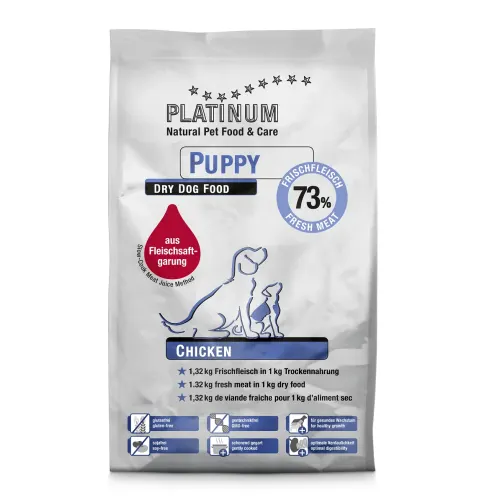
The standard recipes start with at least 70% fresh meat; Puppy Chicken is 73%. That is a meaningful part of the formula, but percentages still need context. Under the “mixing bowl” principle in European pet-food labelling, ingredients are declared by their weight when they are added. Fresh meat contains plenty of water, so a 70% fresh-meat inclusion cannot be compared directly with the percentage of a dried protein on a dry-matter basis.
“Complete food” is the most important part. FEDIAF defines a complete pet food as one that can provide the daily ration for the pet and life stage stated on the label when fed as directed.

It is also worth reading beyond the protein named on the front of the bag:
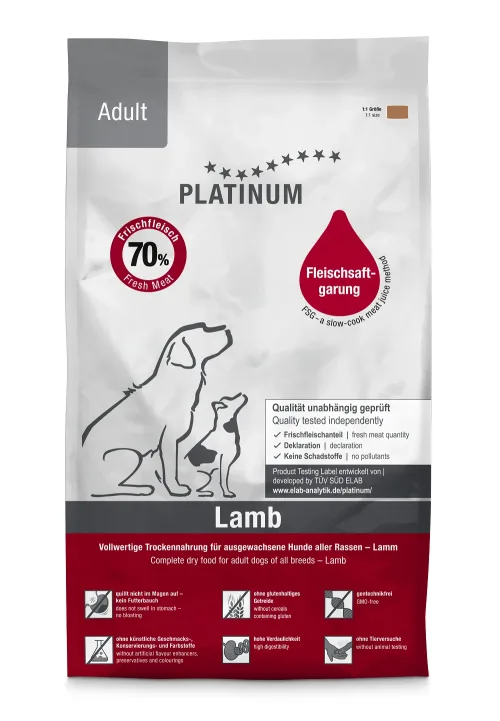
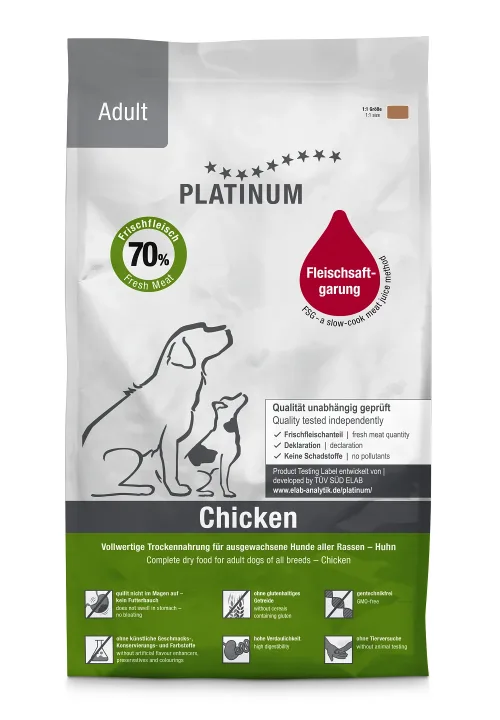
- Adult Chicken contains fresh chicken, broken rice and maize, as well as salmon oil. It is not grain-free.
- Adult Lamb contains fresh lamb and broken rice, but also dried fish, salmon oil and green-lipped mussel extract.
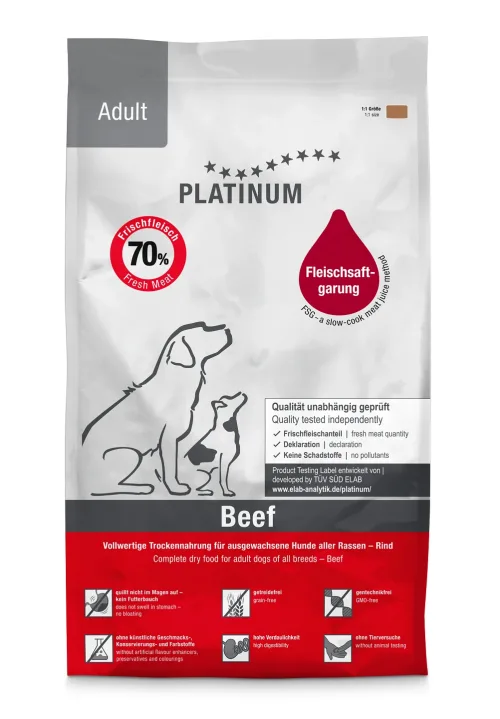
- Adult Beef uses potatoes, peas and lentils rather than grains, and also lists dried fish and salmon oil.
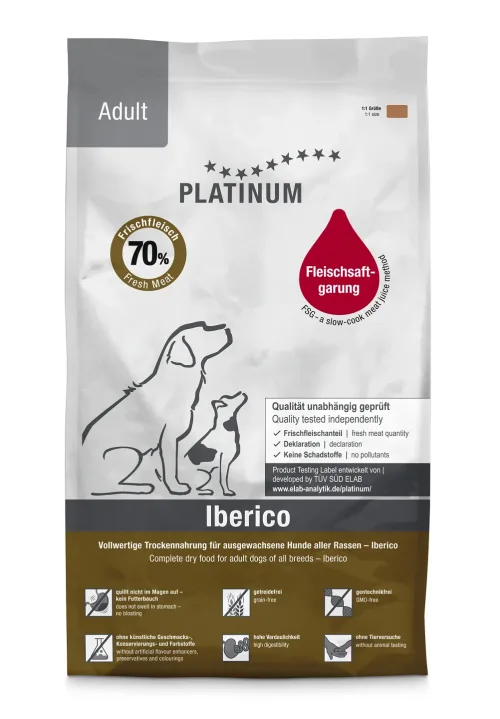
- Adult Iberico uses Iberian pork with potatoes, and also lists dried fish and salmon oil.
- Puppy Chicken contains fresh chicken and broken rice, plus dried fish and salmon oil.
Which PLATINUM recipe should you choose?
Start with your dog's needs, not the flavour name that sounds most appealing to you.
For healthy adult dogs
At the time of writing, the PLATINUM selection at Koerland includes Adult Chicken, Adult Beef, Adult Lamb and Adult Iberico in 1.5 kg and 5 kg bags. All four are complete foods for dogs.
Chicken uses rice and maize. Lamb uses rice. Beef and Iberico use potatoes and legumes instead of grains. If your aim is to avoid a particular grain or animal ingredient, read the full composition rather than relying on terms such as “grain-free,” “high meat” or the recipe name.
For puppies and young dogs
Puppy Chicken is formulated as complete food for puppies and young dogs. Growth changes a dog's energy and nutrient needs, so an adult recipe should not be chosen simply because the pieces look similar. Follow the puppy feeding table and optionally speak with your veterinarian about the right time to move to adult food, especially for a large-breed puppy.
For older, less-active or food-sensitive dogs
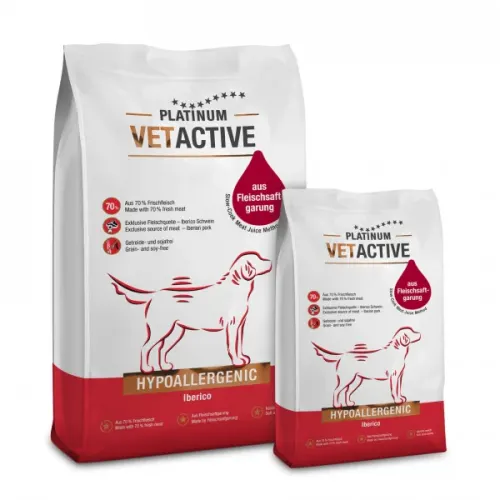
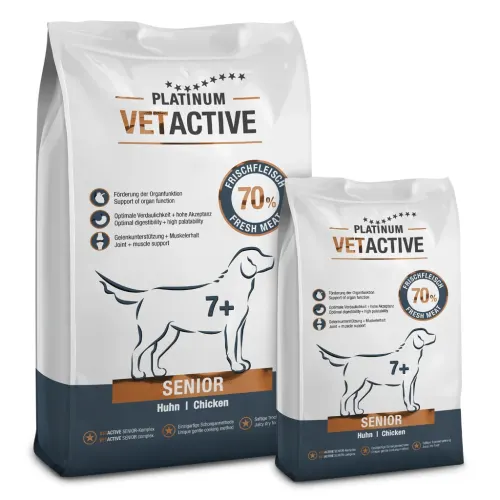
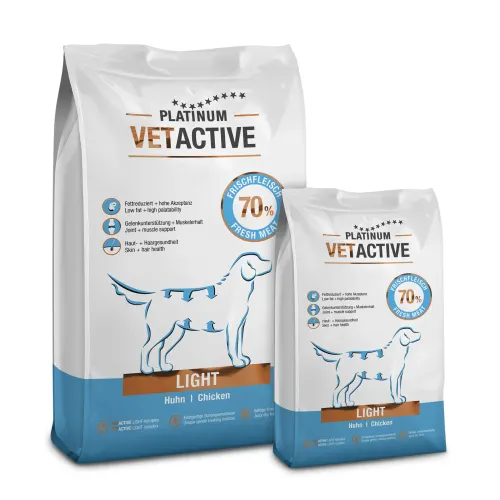
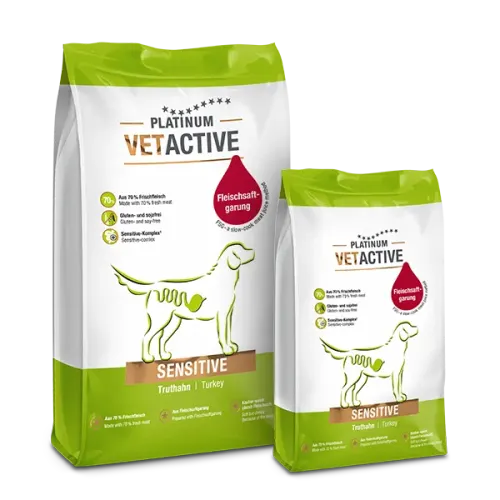
We also have VetActive Sensitive, Hypoallergenic, Light Chicken and Senior Chicken. These names can help narrow the options, but they are not a diagnosis. “Light” does not automatically mean the portion can be guessed, and “hypoallergenic” does not mean the recipe is suitable for every allergy.
What about the claim that the food does not swell?
PLATINUM says its soft pieces do not swell in the stomach and links this property to a lower risk of gastric torsion, also called gastric dilatation-volvulus or GDV.
GDV is a complex, life-threatening emergency. Veterinary references identify several associated factors, including breed and body shape, age, eating quickly, stress and feeding pattern. They do not present one cooking method as protection. The Merck Veterinary Manual overview of GDV is a useful starting point. If a dog has a swollen or painful abdomen, repeated unproductive retching, marked restlessness, weakness or collapse, contact an emergency veterinarian immediately.
How to feed PLATINUM dog food
Use the feeding table as a starting point and measure the portion in grams with a kitchen scale. Do not reuse a scoop or cup setting from a previous food: piece size, moisture and calories per gram vary between recipes. Start near the lower end of the stated range, then adjust gradually according to your dog's weight trend, activity and body condition. Keep fresh water available.
PLATINUM recommends changing directly to its dry food without a transition period. Once the change is complete, pay attention to the dog in front of you. Appetite, stool quality, skin, body weight and energy level are more informative than a fashionable production term. Recheck the portion as activity, age or health changes.
A different texture, with the same basic questions
FSG gives PLATINUM dry dog food a genuinely different texture and production story. The high fresh-meat inclusion, soft pieces and published laboratory test plans may all be relevant when you compare products.
They do not remove the need to read the label. Check that the food is complete for your dog's life stage, identify every grain and animal-derived ingredient, weigh the portion and be careful with medical claims. No production method or recipe suits every dog.
If the soft, meat-juice-cooked format sounds practical for your dog, browse the PLATINUM range available at Koerland and compare the individual compositions before choosing.

Sources
- PLATINUM: company milestones
- PLATINUM: Fleischsaftgarung
- PLATINUM: dry dog food and product declarations
- Koerland: current PLATINUM selection and product compositions
- ELAB Analytik: PLATINUM test plans and scope
- FEDIAF Code of Good Labelling Practice for Pet Food
- FEDIAF Nutritional Guidelines for Complete and Complementary Pet Food
- FEDIAF: Understanding pet-food labels
- Tran, Hendriks and van der Poel: Effects of extrusion processing on nutrients in dry pet food

Mart
PLATINUM Dog Food, premium food for dog
PLATINUM: 70% fresh meat, cooked in its own juices. Prevents bloating, supports healthy digestion, and reduces the risk of stomach upset. Made using the FSG method. Shop Now!
View PLATINUM brand page